

Betting Model for Yellow/Red Cards: Referees, Matchups and Game Context (2026)
Cards markets look simple on the surface, but they’re driven by a mix of law, officiating style, tactical collisions and the moment-by-moment temperature of the match. A workable model doesn’t try to “predict drama”; it estimates how often specific behaviours (late tackles, dissent, tactical fouls, time-wasting, denial of promising attacks) appear under particular referees, between particular teams, in particular contexts. In 2026, that means respecting competition rules, VAR processes and the way game management changes with scoreline, fatigue and stakes.
1) Start with rules and competition context, not raw averages
Your baseline should reflect the competition you’re pricing. Cards are recorded the same way, but suspension rules, incentives and match importance differ wildly across leagues and tournaments. Even within Europe, clubs often manage risk around accumulations and stage-specific wipe rules, which can change how aggressively players behave when already on a booking.
Build separate baselines for league matches, domestic cups and continental competitions, then blend them only if you have a strong reason. For example, a mid-table league match played three days before a cup semi-final can produce “managed intensity” (more tactical fouls early, fewer reckless challenges late), while a relegation six-pointer can create the opposite: more transitional fouls and more dissent.
Finally, tag every match with stakes indicators that your model can read: table pressure, knockout/tie legs, away-goal irrelevance (modern era), and “must-not-lose” incentives. These don’t need to be perfect—simple proxies (points needed, leg number, qualification thresholds) often beat subjective narratives.
How the Laws and modern officiating mechanics affect modelling
Cards are still governed by the same backbone: cautionable offences and sending-off offences. What changes the market shape in 2026 is how competitions implement guidance around match control. If a competition encourages only the captain to approach the referee after key incidents, that can reduce clusters of dissent bookings that previously appeared after controversial moments.
VAR doesn’t “cause” cards in a straight line, but it can alter timing and certainty. A long VAR check slows tempo, changes emotions and can lead to the next stoppage becoming the flashpoint (crowding, sarcastic applause, delaying restarts). Some competitions now allow referees to announce and explain the final decision after a review or lengthy check, which may reduce confusion-driven confrontations in certain environments.
Also be aware of where temporary dismissals (sin bins) are used. They are not a mainstream elite standard everywhere, but they exist in parts of the football pyramid and can change the relationship between dissent and yellow cards. If you price lower-tier or youth competitions, treat sin-bin rules as a structural break: dissent might be punished differently, and the remaining card count can shift.
2) Referee profile: separate “rate”, “triggers” and “game management”
Many bettors stop at “cards per match”. That’s too blunt. A referee profile is three models in one: (1) overall card rate, (2) which triggers produce those cards, and (3) how the referee manages escalation once the match becomes hot. Two referees can average the same total, yet behave differently—one books early to set boundaries; the other warns early and then produces a burst around minute 70.
Start with stable referee features: historical yellows/reds per 90, foul-to-card conversion, advantage usage, tolerance for contact, and typical timing of first caution. Then add context interactions: derby games, underdog leading late, or high-press matchups where “tactical grab” fouls are common. Referees are not robots; the point is to quantify their tendencies without turning them into a storyline.
Include discipline for benches and staff when your market counts it. In some competitions, team officials are shown cards and can be suspended; even if your bet is “player cards only”, staff discipline can be an early signal that the referee will not tolerate escalation. Treat it as a live feature, not a pre-match assumption.
Practical feature engineering for referees
Use rolling windows and shrinkage. A referee’s last 6–10 matches can capture recent instruction emphasis, but it’s noisy. Blend recent form with a long-run average using a simple Bayesian prior or ridge regularisation. This avoids chasing a couple of outlier matches where one red card inflated everything.
Model “state-dependent strictness”. Split historical matches by game state: 0–0, favourite leading, underdog leading, and late tight games. Some referees clamp down when the underdog leads (more time-wasting enforcement), while others let the game breathe and only book for obvious tactical fouls. You can encode this as interaction terms between referee ID and score-state bins.
Finally, treat referee assignment as information, but not prophecy. If a league is known for consistent refereeing directives, the assignment might signal the organiser’s preference for control in a high-risk fixture. Your model should translate that into slightly higher expected cards—without leaping to extremes unless the rest of the inputs also point that way.
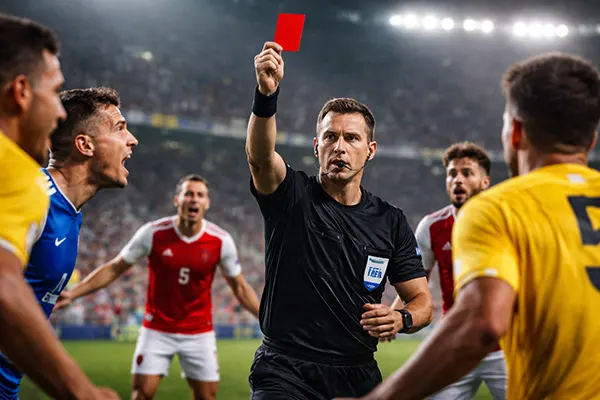
3) Team matchups and in-play context: where the edge usually lives
The cleanest cards signal is often tactical collision: high press versus build-up risk, dribble-heavy wings versus aggressive full-backs, or a transition team versus a slow defensive line forced into “professional” fouls. Build team-style vectors that stay stable across opponents: press intensity, duels per 90, aerial reliance, dribbles faced, and defensive line height proxies.
Then add matchup features: which side is likely to spend long spells defending wide, which midfielders are exposed in transitions, and whether either team relies on tactical fouls to stop counters. Cards are frequently about preventing danger, not about violence, so transitions and counter-press sequences matter more than possession share alone.
For live betting, game context is king. The same two teams can produce different card paths depending on the first goal, an early booking for a key defender, weather slowing the pitch, or a tactical switch that floods zones with runners. Your live model should re-price every stoppage cycle, not only after goals.
In-play adjustment rules you can actually apply
Scoreline and time are the first adjustment. When a team protects a one-goal lead late, expect more time-management behaviour (delayed restarts, holding the ball in corners, tactical fouls after turnovers). That often increases the probability of at least one late yellow, even if the match was quiet earlier.
Second, track “constraint events”: a defender booked before minute 25, a striker repeatedly fouled in isolation, or a referee issuing multiple firm warnings without a card. These shift behaviour. A booked full-back facing a dribbler may stop diving in—reducing his own card risk—while increasing the chance of a tactical foul by the covering midfielder. Your model should move risk between positions, not only up or down for the whole match.
Third, price discipline with risk control. Cards markets can swing on one chaotic moment. Set limits per match, use fractional staking, and avoid chasing losses in-play. If your edge depends on live reads (tempo, referee body language, crowd pressure), be honest: that’s harder to systemise. The safest approach is to encode only what you can measure consistently and treat the rest as “do nothing” signals.
Popular articles
-
 Which of the top clubs in Europe had ...
January is usually quiet for transfers, but the Premier League’s …
-
 How Changes in Motorsport Rules Affec...
Motorsport is a dynamic industry where regulations change frequently to …
-
 How Refereeing Style Influences Fouls...
In modern sports betting, marginal differences often define long-term profitability. …