
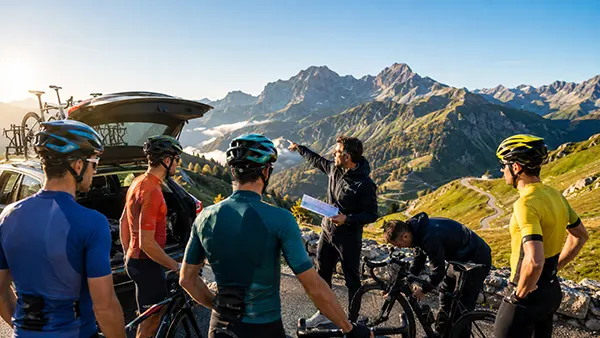
Tour de France 2026: How Mountain Profiles and Team Tactics Change the Odds
The Tour de France 2026 was designed to make the general classification unstable from the opening week to the final Alpine weekend. Across 3,320.7 kilometres, the race includes eight mountain stages, five summit finishes, a team time trial in Barcelona and an individual time trial beside Lake Geneva. The route crosses the Pyrenees, Massif Central, Vosges, Jura and Alps, so the leading riders must repeatedly prove themselves on different types of terrain rather than surviving one decisive mountain block. This matters when reading betting odds because a price is not based only on a rider’s reputation. It also reflects the length and gradient of the climbs, where they appear in the stage, how much support a rider still has, the current time gaps and the tactical choices available to rival teams. The same rider can therefore be a strong favourite for the yellow jersey but a weaker choice for a particular mountain stage, especially when a breakaway has room to stay clear.
Why the 2026 Mountain Route Changes Market Expectations
The first important feature is how early the climbing begins. Stage 3 from Granollers to Les Angles contains 3,850 metres of elevation gain over 195.9 kilometres, including the first-category Col de Toses and a high-altitude finish. It is not the hardest day of the race, but it arrives before teams have settled into a predictable rhythm. An early mountain stage creates several forms of uncertainty: some general classification contenders may still be recovering from the opening team time trial, teams may not yet know which domestiques are strongest, and riders who arrived with unclear form can gain or lose credibility in a single afternoon. Pre-race odds are partly built on results from earlier events, training reports and historical performance. Once the Tour reaches its first serious climbs, those assumptions are replaced by evidence from the race itself. A convincing ride can shorten a contender’s outright price even when the actual time gain is small, while visible weakness can produce a sharp reaction.
Stage 6 from Pau to Gavarnie-Gèdre provides a different test. The stage covers 186.2 kilometres with 4,100 metres of climbing and places the Col d’Aspin before the Col du Tourmalet, a 17.1-kilometre ascent averaging 7.3 per cent. The finish at Gavarnie-Gèdre is longer but less severe on paper, averaging 3.7 per cent over 18.7 kilometres. That combination changes the likely race pattern. The Tourmalet can reduce the main group and expose riders who struggle at altitude, yet the gentler final ascent may allow a well-organised chase to limit losses or bring back an attacker who moved too early. For stage betting, this profile does not automatically favour the rider with the best short uphill acceleration. It can reward endurance, positioning and team support after the hardest classified climb has already been crossed. For outright odds, the main question is often not who wins the stage, but which contender remains calm and protected when the race becomes stretched across the Tourmalet.
The middle weekend increases the value of recovery and consistency. Stage 14 to Le Markstein Fellering includes 3,800 metres of elevation gain, with the Grand Ballon, Ballon d’Alsace and the 11.2-kilometre Col du Haag packed into 155.3 kilometres. Stage 15 then adds 3,950 metres over 183.9 kilometres before the hors catégorie finish at Plateau de Solaison, where the final 11.3 kilometres average 9 per cent. The preceding Col de la Croisette is only 4.7 kilometres long but averages 11.2 per cent, so riders can reach the final climb with damaged legs and reduced team support. Odds may move after Stage 14 even when the leading favourites finish together, because the market also responds to how they rode: who needed teammates, who closed attacks personally, who looked comfortable and who was isolated. The following day then tests whether that impression was genuine or simply the result of one strong performance.
Not Every Summit Finish Favours the Same Type of Rider
A summit finish is often treated as a simple signal that the strongest climber should be favourite, but the details are more important than the label. A long climb at a steady gradient tends to reward riders who can sustain a high pace and avoid sudden changes of speed. A shorter, steeper finish can favour explosive climbers who are able to wait and attack in the final kilometres. A climb reached after several difficult passes is also different from an isolated ascent at the end of a relatively calm stage. The amount of work completed before the final mountain affects how many domestiques remain, whether a team can control the breakaway and how much energy the leaders have for repeated attacks. This is why prices for the same rider can vary considerably between two mountain stages held only a day apart. The rider’s ability has not changed overnight, but the tactical problem has.
Stage 18 to Orcières-Merlette and Stage 19 to Alpe d’Huez show the contrast clearly. Orcières-Merlette ends with 7.1 kilometres at 6.7 per cent after a 185.2-kilometre day containing 3,900 metres of elevation gain. The final climb is difficult, yet its moderate average gradient can support a controlled tempo and a late acceleration. Stage 19 is much shorter at 127.9 kilometres, but still contains 3,500 metres of climbing and finishes with the classic 13.7-kilometre ascent of Alpe d’Huez at 8.1 per cent. Short mountain stages often encourage aggressive racing because there is less flat road on which a strong team can restore order. An attack on the Col du Noyer or an intense pace from the opening Col Bayard can remove helpers long before the final climb. As a result, a general classification favourite may deserve a short outright price while still facing meaningful risk in the daily stage market.
Stage 20 is the clearest example of endurance reshaping probability. The route from Le Bourg-d’Oisans to Alpe d’Huez is 170.9 kilometres long with 5,450 metres of elevation gain. It includes the 24-kilometre Col de la Croix de Fer, the Col du Télégraphe, the 2,642-metre Col du Galibier and the Col de Sarenne before the finish. A rider who is excellent on one climb can still lose time after several hours of repeated ascending, descending, feeding and positioning. Team depth becomes especially valuable because the leader may need support in the valley, on the approach to the Galibier and again before Sarenne. The final mountain stage also changes tactical incentives: riders defending a podium place may ride conservatively, while those outside their target position have little reason to wait. That mix can make the race more volatile than the outright odds suggest.
How Team Tactics Turn Route Data into Changing Odds
Mountain stages are decided by individuals, but the circumstances in which those individuals compete are created by teams. A general classification leader needs teammates to control the early breakaway, collect food and bottles, provide shelter in exposed sections, set a manageable pace and respond when rivals send riders up the road. When a leader reaches the final climb with two strong helpers, the team can discourage attacks and choose the moment when the race becomes selective. When the same leader is isolated with 40 kilometres remaining, rivals can attack repeatedly and force personal responses. Betting prices often react to isolation before any time gap appears because the tactical risk has already increased. A rider may still look physically strong, but the number of possible threats has grown and the margin for error has narrowed.
The strongest mountain teams also use riders ahead of the main group as tactical assets. A domestique can enter the breakaway, conserve energy and wait for the team leader later in the stage. This “satellite rider” may then provide pacing, food or support through a valley where the leader would otherwise be exposed. The approach is particularly useful on routes with several major climbs separated by descents and flatter sections, such as Stage 20. It can also force the yellow-jersey team to decide whether to chase a break containing a dangerous helper or allow it to build a lead. For odds, the important point is that a breakaway rider’s presence may improve the leader’s chances even if that rider has almost no chance of winning the stage. Markets that focus only on the final climb can underestimate the value of support placed earlier on the road.
The time gap in the general classification determines which team must accept responsibility. A rider defending yellow can often follow rather than initiate, especially when the nearest rival needs several minutes. The challenger must create a difficult race, remove domestiques and attack far enough from the finish to gain meaningful time. This imbalance changes both tactics and prices. A leader with a comfortable advantage may become an even shorter outright favourite despite not chasing the stage victory, because every kilometre completed without incident reduces the opportunities available to rivals. At the same time, the leader may be less attractive in the stage-winner market if the team is willing to let a non-threatening breakaway succeed. Understanding who needs the stage, who needs time and who merely needs control is more useful than assuming every favourite is racing for the same result.
Breakaways, Multiple Leaders and Secondary Goals
The stage-winner market and the overall-winner market answer different questions. On a mountain day, a breakaway can receive ten minutes because none of its riders threatens the yellow jersey. The main contenders may then race intensely against each other without getting close to the stage victory. A strong climber who has already lost substantial time can therefore be a more logical stage candidate than a rider sitting second overall. The start of the stage matters as well. If the opening kilometres are uphill or constantly rolling, powerful climbers can form the break without a long flat chase. If the beginning is flat, teams with strong rouleurs can control which riders escape. The probability of a breakaway succeeding is therefore linked to both the full profile and the priorities of the leading teams, not simply the difficulty of the final ascent.
Teams with more than one highly placed rider can create further uncertainty. One rider may attack while the nominal leader remains in the main group, forcing rivals to chase and spend their helpers. If the move succeeds, the attacker becomes a genuine classification threat; if it fails, the original leader may be fresher for the final climb. This tactical flexibility can make a team stronger than the individual prices of its riders imply. It can also produce confusing live movements: the odds on the attacking rider shorten because of the road position, while the teammate’s price may remain stable because the attack is serving a broader plan. The key is to ask whether the move is intended to win, to force another team to work, to provide support later or to protect a second place in the standings.
Secondary competitions also affect the composition and behaviour of a breakaway. Riders targeting the mountains classification may spend energy contesting early summits, while stage hunters may refuse to help until the decisive section. Teams with sprinters must devote riders to managing the time limit in the gruppetto, reducing the number of helpers available for other objectives. A squad protecting a young-rider jersey or team classification position may chase an attack that appears harmless to the yellow jersey. These motives are easy to miss when attention is fixed on the best-known names, yet they influence the speed of the peloton and the gap allowed to the break. A realistic assessment of stage odds therefore requires an understanding of what each team is trying to protect or gain on that particular day.
How to Read Tour de France Odds During the Mountain Stages
Pre-stage odds are a starting estimate, not a final statement of what will happen. They combine public information, historical performance, recent form, expected tactics and the bookmaker’s margin. Once the stage begins, live prices respond to new evidence: the size and quality of the breakaway, the pace set by the controlling team, mechanical problems, crashes, weather, the number of teammates remaining and the visible condition of the favourites. A rider shortening rapidly in the market has not necessarily become good value; the price may already reflect the advantage. Likewise, a rider drifting after losing contact briefly may still return on a descent or with help from teammates. Mountain racing contains long periods in which road position can be misread without knowing the gradient, wind direction and tactical purpose of an attack.
The most useful comparison is between the demand of the route and the rider’s likely task. For an outright yellow-jersey bet, consistency, time-trial ability, recovery and team strength matter across all 21 stages. For a single mountain stage, breakaway freedom, finishing speed, climbing style and current classification position can matter more. Head-to-head markets introduce another question: does one rider need to attack while the other can simply follow? Podium and top-ten markets may be affected by conservative riding because a rider protecting a position can allow direct rivals for the stage to go clear. Treating every market as a prediction of the same outcome leads to poor analysis. Each price should be linked to a specific result and a specific race scenario.
The 2026 route makes late reactions particularly important because the final Alpine sequence leaves little recovery time. After Orcières-Merlette, the riders face Alpe d’Huez on Stage 19 and then a 5,450-metre mountain marathon on Stage 20. A rider can look secure after one finish and still face a very different problem the following day. As of the start of Stage 19 on 24 July 2026, Tadej Pogačar held a five-minute lead over Remco Evenepoel, with Isaac del Toro third overall. That position naturally made Pogačar a very strong outright favourite, but it did not remove uncertainty from the individual stage markets. A comfortable leader can ride defensively, allow a breakaway to contest the win and focus only on direct rivals. The correct reading of the odds therefore depends on separating the probability of winning the Tour from the probability of winning today.
A Practical Way to Assess the Final Mountain Days
Begin with the shape of the stage rather than the names at the top of the market. Check the total distance, elevation gain, number of major climbs and location of the hardest ascent. A final climb preceded by a long valley gives teams time to reorganise, while consecutive climbs create opportunities for long-range attacks and satellite riders. Compare Stage 19, which is short and finishes on the classic Alpe d’Huez ascent, with Stage 20, which contains 5,450 metres of climbing and reaches the finish after Croix de Fer, Télégraphe, Galibier and Sarenne. Both are labelled mountain stages, but they demand different resources. The first can become an intense contest of acceleration and positioning; the second is more likely to expose fatigue, weak support and poor energy management.
Next, assess the race situation. Identify which teams must chase, which riders are close enough to threaten the general classification and which strong climbers are far enough behind to receive freedom. Consider the previous day as part of the profile because fatigue does not reset at the start line. A rider who attacked repeatedly at Orcières-Merlette may pay for that effort on Alpe d’Huez, while a contender who rode within the team and avoided unnecessary work may improve relative to the market. Team announcements, visible illness, crashes and withdrawals should be treated as material information, but not all reports carry the same reliability. Official race data, direct team statements and confirmed results are stronger evidence than speculation based on a short television image.
Finally, allow for uncertainty. Mountain stages can be transformed by a crash, a sudden change in weather, an unexpected alliance between teams or a breakaway that gains more time than expected. Odds move because the available information changes, not because the outcome has become certain. The most grounded approach is to connect each price with a clear tactical scenario: who controls the stage, where the decisive selection is likely to happen, which riders still have support and what result each team actually needs. The 2026 Tour shows why this matters. Its mountain profiles are varied enough that no single formula applies from Les Angles to Plateau de Solaison or from Orcières-Merlette to Alpe d’Huez. Route analysis narrows the possibilities, while team tactics determine which of them becomes real.
Popular articles
-
 Australian Open 2024: Expert Betting ...
As the tennis world anticipates the Australian Open 2024, enthusiasts …
-
 Third ODI Showdown: England vs. New Z...
The sport of cricket is no stranger to nail-biting finishes …
-
 Table Tennis Betting: Why Short Forma...
Table tennis is one of the fastest sports available to …